Read field trip reports and view highlight photos from past trips taken by the Illinois Young Birders Club. Trip reports are written by both young birders and adults. If you would like to contribute, let us know!
Report by: Josh Engel
About 12 young birders and their parents met on November 5th for a lakewatch at Wilmette's Gillson Park, Illinois' premier lakewatching site. Enthusiasm was high as scopes were lined up in front of the beach house. We watched a slow but steady trickle of ducks flying past, most of them quite far offshore, including Common Goldeneye, Red-breasted Merganser, and scaup. A single scoter also flew past, identified by Ethan Gyllenhaal as a Surf Scoter. Loons were also moving, including a few that flew inland over Gillson Park proper.
Two Bonaparte's Gulls spent much of the morning with the small gull flock on the beach in front of the beach house. We also saw a few Snow Buntings, including one that landed on the beach, and everyone momentarily silenced themselves in time to hear a Pine Siskin migrating overhead.
A few of us continued after the lakewatch to the opposite end of the park where we found several groups of Redheads sitting on the water, bobbing in the waves. It was a great learning experience for everyone as we discussed how, when, and where to lakewatch, waterbird identification, and of course a variety of other bird-themed topics.
Report by: Brian Herriott
At 10am, a small group of ILYB members met in the parking lot at the base of the hill. Since the hawk watch didn't start until 11am, we had a bit of time to walk around the grassy area and on a short trail through the woods nearby. Unfortunately, the winds were steady out of the southwest, which is not ideal for hawk movement.
There were, however, several migrants to be found. From the parking lot we were able to find a group of 10+ White-crowned Sparrows, a female Indigo Bunting, a local Red-tailed Hawk, Chipping Sparrow, White-throated Sparrow, and Yellow-rumped Warbler. Most of the fall migrants seemed to have moved south. While walking through the woods, we did have a nice little surprise: a Scarlet Tanager! There were also the usual forest birds, including White-breasted Nuthatch, Black-capped Chickadee, Red-bellied Woodpecker, Downy Woodpecker, and many Yellow-rumped Warblers.
At 11am, we made our way to the hill and drove all the way to the top. If you haven't been to Greene Valley before, I highly recommend going, even if you're not a birder. The view is quite nice and you can see the skyline of Chicago on a clear day.
As we arrived at the hawkwatch, we were informed we had just missed an Osprey flyover (which would turn out to be the best bird of the day). Birding is often about being in the ight place at the right time.
We spent the next couple of hours scanning the sky for hawks, sharing the hill with remote-control airplane enthusiasts. At times, the local Red-tail would fly close to the planes to investigate. We had a few Sharp-shinned Hawks fly over and a probably Northern Harrier, but not much else because of the winds. It was, as always, good to be outside with good company.
Leader & Report by: Matt Fraker
On the evening of September 17, I met Brian Herriott and a small group of the Illinois Young Birders at TGIFs. We were going on a field outing the next day. The next morning broke dreary and wet. We had a good crew of youngsters and parents that numbered 16.
We started at Ewing Park looking for fall migrants. We immediately ran into Dale Birkenholz, who was less than encouraging about the scene here. We then ran into Les Allen who joined our clan and eventually migrants started dropping in out of the mist for our entertainment. One of the first birds we found for pretty decent looks was a wonderful Olive-sided Flycatcher. After scouring through a couple of other feeding flocks, we headed out to our next stop at the south side of Evergreen Lake. Here we had a Lesser Yellowlegs and a nicely posed Osprey, among some other day birds.
Following a quick empty stop at the Spillway, we drove up to El Paso, car pooled ourselves down to three vehicles, and went to the El Paso Sewage Lagoons where misty winds hindered our viewing. We just barely managed some Pectoral Sandpipers, a single Semipalmated Sandpiper and a lone Buff-breasted Sandpiper found by Brian. The little sandy flat that has been so productive had been drained and groomed rendering it devoid.
Next, it was off to the Fraker Farm for a much needed Avanti's lunch. The weather broke a bit for us and we took to the Farm for a nice long nature loop. With the rain and cool temps I was skeptical about our snake finding chances and expected to whip through our walk. I was not prepared for a five species snake day...and this completely compensated for the weather and the sketchy birding. We have never had five species in a run.
Here is a summary gallery of our snakes for the day -- 11 caught, 13 seen (one unidentified):
We also had two species of Ladies tresses Orchids -- the spiral (gracilis) and I think the Great Plains (magnicamporum).
By day's end we had amassed (somehow) a day list of 70 bird species on top of the five snake species. All in all, it was a tremendous outing with an excellent group of impressively bright and talented youngsters, all of which took turns handling the snakes and in many cases found some of our birds. Thanks also to the parents who encourage these young 'uns. You will be rewarded for this someday.
Leader: Ted Hartzler. Photos: Ethan Gyllenhaal
The Illinois Young Birders field trip yesterday to the Emiquon Preserve and
Chautauqua Refuge produced a nice tally of shorebirds on a beautiful, sunny
day. We started the morning with a brief stop at the observation platform at
Emiquon Preserve overlooking Thompson Lake. We immediately found a small flock
of Eurasian Tree Sparrows, a couple hundred American White Pelicans, some Great
Egrets, and a flyby Yellow-billed Cuckoo. The only shorebird at this location
was Killdeer.
Leader: Scott Cohrs. Report written by Scott Cohrs. Photos: Denise Haberkorn
I had the pleasure of leading several members of the Illinois Young Birders Club around some of the Kane County sites on July 30th. The original plan was to target several shorebird spots, but heavy rains earlier in the week washed out some of our target areas. Regardless, it was a fun (and hot) outing with several good birds.
The first stop was Nelson Lake. A view from the observation platform produced a few Wood Ducks, Pied-billed Grebe, distant shorebirds, and a Killdeer doing a nice Black Tern impression. Marsh Wrens and Swamp Sparrows could be heard singing from the reeds. The north end of the marsh did produce some shorebirds, including 2 Solitary Sandpipers, 3 Semipalmated Sandpipers, and 5 Least Sandpipers. We did not relocate a Baird’s that had been seen there earlier. In all, Nelson Lake produced 32 species.
The next stop was Aurora West. If anyone wants to see or hear Willow Flycatchers, this is the spot. A conservative estimate totaled 15 individuals. The other big highlight was a Bell’s Vireo. It was seen a few times, and cooperatively sang as well. Unfortunately, the heat was building, and some of the other specialties at this spot remained quiet. There were 19 species at Aurora West.
A quick stop at Sauer FP did not produce the hoped-for Western Meadowlark, but we promptly picked that up at the Kaneville Sod farm. This bird was particularly rewarding. There was some friendly debate going on about Eastern vs. Western when the bird promptly sang, removing any doubt. I believe it was a life bird for a couple trip participants.
From there it was on to our last stop, Elburn FP. The slough across the street contained breeding Common Moorhens, and several of us were able to get nice views of both adult and juvenile birds. After scoping to see if there were any hidden shorebirds or rails, it was time for a nice picnic lunch in the shade of the pavilion. I think everyone was happy to sit in the shade and relax for a bit. A similar trip was planned at the same time last year. Unfortunately, it was entirely flooded out. This year we did get the trip in, though shorebirds were certainly affected by the weather during the week. One of these years we will actually get to do some shorebirding!
Leader: Bob Fisher. Sponsor: DuPage Birding Club. Report written by Bob Fisher and Ethan Gyllenhaal.
A joint DuPage Birding Club and IL Young Birders outing made the rounds at Lowden Miller Saturday morning. The mosquitos were ferocious, and the birds were mostly silent, so the birding overall was pretty slow. The various breeding warbler species at Lowden proved especially hard to see, staying up in the trees and rarely singing. Good looks at Acadian Flycatchers, a frenetic Kentucky Warbler, and a
Barred Owl which followed us around for a bit were the highlights of an otherwise rather disappointing day. Happily, nobody was carried off by the mosquitos, nor were any blood transfusions necessary to replace lost blood from mosquito bites. But the smell of repellent is probably still lingering in the woods!
At Nachusa Grasslands, the weather was beautiful, and although we missed Lark Sparrow we did have Grasshopper and Henslow's Sparrows. We also had 2-3 Willow Flycatchers, 1 Orchard Oriole, and 1 Northern Mockingbird. This was from the gravel lot leading to a few paths through the prairie, I believe along Lowden Road.
Some interesting insects included many flower beetles, a Robber Fly (who used some of our shirts to sit down and eat its catch), and milkweed beetles, but very few butterflies. Lowden Miller, on the other hand, had dozens of Hackberry Emperors.
A lively group of eight young birders and a few more adults gathered at the entrance to the Magic Hedge at Montrose on Saturday, May 28, 2011. The weather was not very friendly with mostly overcast skies and temperatures in the upper fifties Fahrenheit. Shorebirds were in short supply, with only two Dunlins, in addition to the resident Killdeer and Spotted Sandpipers. Flycatchers were seen in good numbers and we were all astonished by the great number (5) of Yellow-bellied Flycatchers. We saw a good variety of swallows, namely Tree, Bank, Barn, Northern rough-winged, and Purple Martin. We had eleven species of warblers, best among them a female Mourning Warbler.
The highlight at Montrose came late when we were just about ready to leave: an Osprey was flying North over the beach house––a late migrant or a bird displaced by the recent storms?
At Jarvis, we were told that a Cerulean Warbler had been seen earlier in the morning. Our search only produced glimpses at a potential candidate but no views that would have allowed a confirmation. Twelve warbler species were seen, among them a beautiful male Blackburnian and Bay-breasted Warbler, each. Two late White-throated Sparrows were hanging around in the grasses on the South of the sanctuary. All in all, the shear number of birds seemed low, even for the later part of migration. Yet, it was a very enjoyable trip and I hope that all of the participants felt the same way.
Many thanks to Sam Burckhardt for leading the field trip and for writing this trip report. Also, thanks to our partner member, The Chicago Ornithological Society for organizing and sponsoring this field trip.
Species list compiled by ILYB member Nandu Dubey (We also had a very bleached Ring-billed Gull):
| 2 Mallard 4 Great Egret 1 Green Heron 1 Osprey 1 Killdeer 2 Spotted Sandpiper 2 Dunlin 34 Ring-billed Gull 2 Herring Gull 1 Caspian Tern 230 Chimney Swift 6 Yellow-bellied Flycatcher 1 Willow Flycatcher |
1 Alder/Willow Flycatcher (Traill's) 2 Least Flycatcher 1 Red-eyed Vireo 2 American Crow 8 N. Rough-winged Swallow 6 Tree Swallow 17 Barn Swallow 1 House Wren 1 Gray-cheeked Thrush 4 American Robin 2 Gray Catbird 45 Cedar Waxwing |
1 Yellow Warbler 1 Magnolia Warbler 1 Blackpoll Warbler 4 American Redstart 1 Mourning Warbler 6 Common Yellowthroat 1 Wilson's Warbler 2 Northern Cardinal 12 Red-winged Blackbird 24 Common Grackle 1 House Finch 4 American Goldfinch |
At Jarvis we also had some good warblers including a Bay-breasted. We also got 3
more Yellow-bellied Flycatchers. Here is the list for Jarvis:
4 Wood Duck |
3 Ruby-throated Hummingbird 2 Downy Woodpecker |
4 Yellow-bellied Flycatcher 1 Eastern Phoebe |
12 Barn Swallow 12 European Starling 38 Cedar Waxwing |
Report by: By Ethan Gyllenaal;
Leaders: Vicky Sroczynski and Bob Fisher
Yesterday seems to be the beginning of the major warbler wave. Today was much better, and Waterfall Glen (DuPage County) had a great 15 warbler species, and 71 species total (with few waterbirds and thrushes). Four ILYB members attended this great spring trip: Ari Rice, Nathan Goldberg, Kalman Strauss, and myself.
The Illinois Young Birders met on a chilly, blustery April morning
(Sunday, 17 Apr 2011) at Paul Douglas Forest Preserve's Grassy Ridge
Meadow in northwest Cook County for a field trip co-led by Geoff and
Chris Williamson. A nice assortment of waterfowl, including Gadwall,
Blue-winged Teal, Northern Shoveler, Green-winged Teal, a bunch of
Ring-necked Ducks, and a handful of Bufflehead, kept Tobias Ginsberg
and the other birders glued to the scopes. Great Blue Herons were
sitting atop the nesting structures in the middle of the water, Tree
Swallows were somehow finding insects to eat over the water despite
the cold conditions, and an occasional Red-tailed Hawk soared over
the far tree line. A walk through the nearby field produce some
Eastern Meadowlarks, Killdeer, and a handful of Savannah Sparrows,
but the wind made other land birds scarce.
The group picked up and headed for Baker's Lake. Along the way we
stopped at a slough along Central Avenue that had a beautiful Common
Loon resting on it. It was nice to watch the loon from the cars
without having to expose ourselves to the nippy wind, and Nathan
Goldberg snapped some photos out of the car window. Further along,
an Osprey drifted by overhead, but there was no convenient pull-off
so most of the group missed this bird. We pulled into Ron Beese Park
on the south side of Baker's Lake and once more braved the chill and
wind, though the sun did start peeking out from the clouds to warm
things up a bit. At the large pond in Beese Park, we got some nice
looks at a breeding plumaged Horned
| Canada Goose 24 Wood Duck 2 Gadwall 1 Mallard 40 Blue-winged Teal 28 Northern Shoveler 5 Green-winged Teal 14 Ring-necked Duck 40 Bufflehead 5 Hooded Merganser 7 Red-breasted Merganser 2 Ruddy Duck 1 Common Loon 1 Pied-billed Grebe 5 Horned Grebe 2 Double-crested Cormorant 380 Great Blue Heron 22 Great Egret 115 Black-crowned Night-Heron 8 Turkey Vulture 3 Osprey 1 Cooper's Hawk 4 |
Broad-winged Hawk 3 Red-tailed Hawk 3 American Coot 45 Sandhill Crane 1 Killdeer 8 Wilson's Snipe 6 Ring-billed Gull 18 Herring Gull 2 Caspian Tern 4 Rock Pigeon 4 Mourning Dove 2 Belted Kingfisher 1 Red-headed Woodpecker 1 Red-bellied Woodpecker 6 Downy Woodpecker 3 Hairy Woodpecker 1 Northern Flicker 8 Blue Jay 8 American Crow 6 Tree Swallow 36 Northern Rough-winged Swallow 2 Barn Swallow 6 |
Black-capped Chickadee 10 White-breasted Nuthatch 1 Golden-crowned Kinglet 5 Ruby-crowned Kinglet 3 Eastern Bluebird 1 American Robin 75 European Starling 65 Cedar Waxwing 1 Yellow-rumped Warbler 7 American Tree Sparrow 5 Savannah Sparrow 3 Song Sparrow 14 Swamp Sparrow 6 Northern Cardinal 6 Red-winged Blackbird 120 Eastern Meadowlark 12 Common Grackle 80 Brown-headed Cowbird 20 House Finch 2 American Goldfinch 5 |

Nathan G. talking with Sheryl DeVore and Steve Bailey (photo by Lynne Remington)
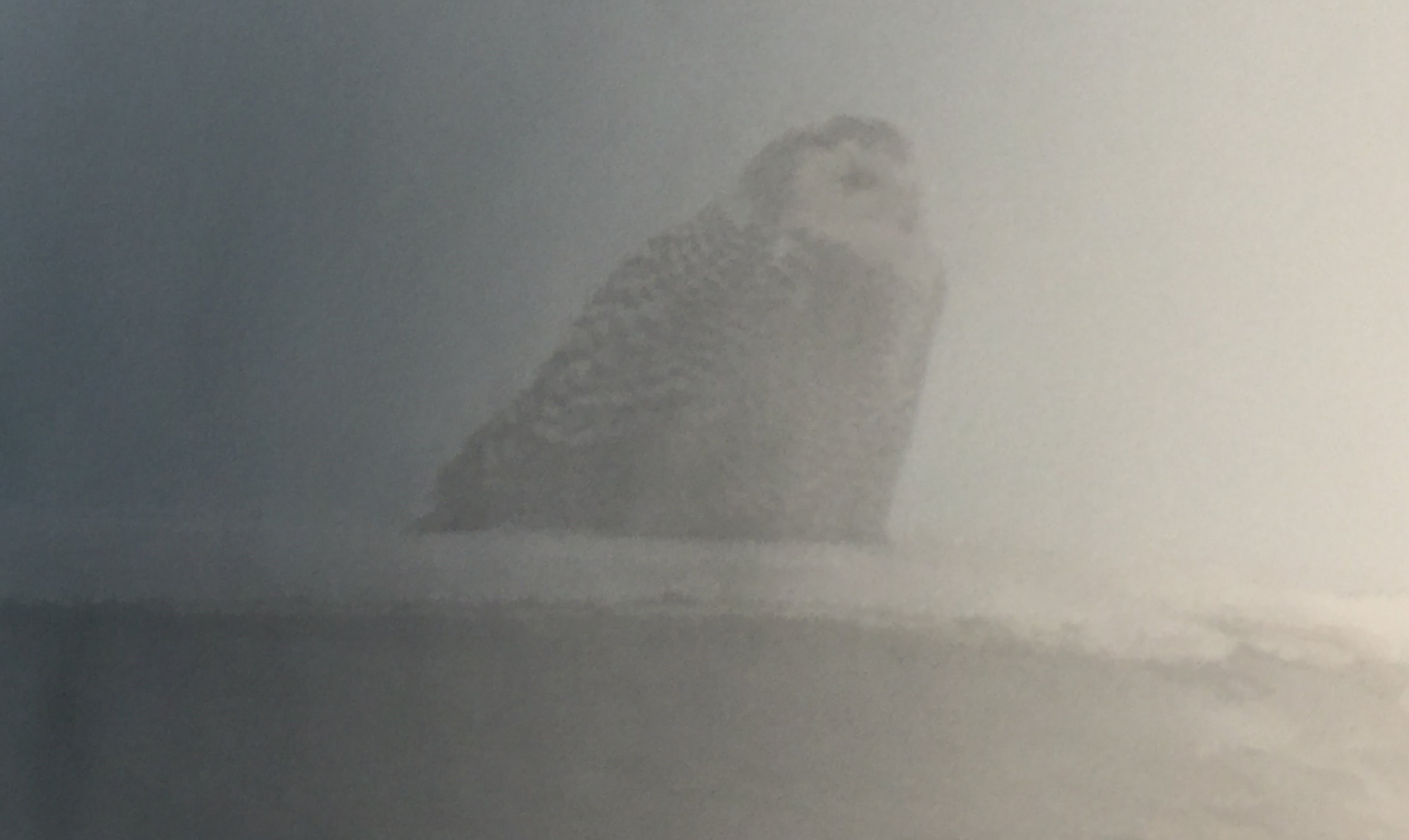
We did see a Snowy Owl! Well. . . . maybe not.

ILYB Members after our walk in the woods.
After we returned to the welcome center at Ryerson, Steve and Sheryl DeVore kindly signed copies of their field guide, ‘Birds of Illinois’. These books were purchased thanks to a grant given to ILYB from the Illinois Department of Natural Resources and their Wildlife Preservation Fund.
We stuck around enjoying hot chocolate and coffee, while trying to warm up after our long walk through the woods. Most of us then headed to a nearby pizza restaurant for a fun dinner together. Although we didn’t see any owls, we all had a great time together and learned a lot from Steve and Sheryl. It was a beautiful night to be out walking in the woods.
*Trip report and photos by Ethan Gyllenhaal* - Today we planned to start at the Starved Rock Eagle festival in hope of some gulls and eagles. Just after getting out of the car, we saw an eagle and an adult Lesser Black-backed Gull. I also saw a relatively pale-mantled gull land in the distance.
After deciding to put it off for unknown reasons, I eventually looked at it through the scope. My instinct after seeing the pale mantle was Glaucous, but
then I saw the dark on the primaries. It was also larger and had a bulkier bill than the surrounding
Herrings. I also noticed that the primaries weren't as dark as the surrounding Herrings, and the dark didn't even do all the way down the exposed primaries.
I knew what this was, an adult Nelson's Gull, possibly backcross with Glaucous based on how pale it was.
Hybrid gulls are always a rush! After I got a couple of crappy photos of it, I went back, and Brian Herriott had gotten on an adult Thayer's Gull. The Nelson's then came in closer, but was quickly blocked by Herrings. A Canvasback also flew by while we were
watching the Nelson's. As I was taking one last look at the Nelson's, I realized there was a 2nd cycle Thayer's a few rows in front of it!
We then went up to the balcony to get a better view of the dam. There were plenty of eagles, but no "good" gulls showed up for a while. Eventually, I saw a white-winged gull. It ended up being an adult Kumlien's, after I spent a minute trying to get better views of the wing. A/the adult Thayer's arrived soon after, and the started fishing in the same area. A/the Lesser Black-backed also showed up. Finally, the Nelson's flew in! It was a nice bird to watch in flight, looking like a Glaucous until you saw the primaries. It wasn't too tough to pick out with the naked eye!
Next up was the "real" Starved Rock. We quickly found a nice array of birds at the feeders, including Red-bellied Woodpeckers, Pine Siskins, American Tree-sparrows, Juncos, Cowbirds, White-breasted Nuthatches, and eventually a female Red-winged Blackbird showed up. After seeing what the inside of the lodge had to offer, I went back out and instantly heard a Pileated Woodpecker. A male appeared pretty close after a bit of looking, and a female lurked a bit lower. The male eventually went to the top of a dead tree, and showed off to all who passed by.
Five members of ILYB attended this event, which started with a bird walk from the nature center at the south unit at 7:30am. Although not much was seen, it was a beautiful morning to be walking around. Field Sparrow, Golden-crowned Kinglet, Red-bellied Woodpecker, and some Bufflehead were found as well. After returning to the nature center, Vic Berardi gave an excellent presentation on raptors that migrate over Illinois Beach State Park. All of the photographs were taken by Vic and we all learned a good deal about weather patterns and how it effects raptor migration.
After the presentation, we headed up to the North Unit of ILBSP to attend the hawkwatch itself. Unfortunately, winds were out of the southwest which are not favorable for hawk migration. Fortunately, the volunteer staff at the hawkwatch had lots of fun activities planned for the day.
The good people at Flint Creek Wildlife Rehabilitation Center had brought out 4 live raptors for up-close viewing. All of these birds had been rescued and were no longer able to fly in the wild. These included
2 Red-tailed Hawks, a Sharp-shinned Hawk, and a Turkey Vulture. Janice Sweet had also created a beanbag throwing game which helped educate kids about raptor migration. I found out quickly that I’m a horrible beanbag thrower!
Although the weather was not ideal, we did see some birds overhead and in the grasses surrounding the hawkwatch. While looking for sparrows, Tobias Ginsberg and Nandu Dubey spotted a distant Merlin quickly moving southeast. We also had a Pine Siskin and White-crowned Sparrow nearby.
Soon thereafter, we had a small group of hawks flyby that included 2 Red-tailed Hawks and a beautiful Northern Harrier adult male. Nathan Goldberg came up the hill and was very excited about finding a new state and life bird — LeConte’s Sparrow! Ethan and Aaron Gyllenhaal and Nandu Dubey also saw this bird along with some more Pine Siskins. It was a ‘lifer’ for Nandu as well. Congrats guys!
*Below is Geoff Williamson’s trip report detailing the excellent trip to ‘the Magic Hedge’ on Chicago’s lakefront. Many thanks to them for their excellent leadership and to those who made the trip.
Christine and I had the opportunity to explore Montrose Point in Chicago’s Lincoln Park today (Saturday, 18 Sep 2010) with some of Illinois’s finest young birders. We were billed as the leaders of the field trip, but with six pairs of keen young eyes it seemed that it was us who were led by them.
We started at 8:00am working the famous Magic Hedge at Montrose, with good looks at a variety of warbler species including NASHVILLE WARBLER, BLACKPOLL WARBLER, and WILSON’S WARBLER. A GRAY-CHEEKED THRUSH gave its nocturnal flight call while we were looking at the warblers. Nandu Dubey caught up with us, and he enjoyed the views of warblers and flycatchers and sparrows on his first visit to Montrose Point. We were heading for the beach when some of us spotted another warbler in a tree at the north end of the meadow. When we got a look at this bird, I wasn’t sure what it was. It looked like a Yellow-rumped Warbler, but then it didn’t. It called a few times and when it flew, the bright yellow rump patch confirmed it as a Yellow-rumped, but I’m convinced it was the western form, AUDUBON’S WARBLER. Half the group had to be brought back from the beach, and we went over to Montrose’s “Water Feature,” where this bird had flown. We got to see lots more warblers, but no luck finding this bird. We wandered off, and were trying to track down a calling RED-BREASTED NUTHATCH when word came that Ethan Gyllenhaal had relocated the AUDUBON’S WARBLER. We hustled over to where he was, but were unsuccessful in pinning this elusive creature down, though we did see a blue BUDGERIGAR right there.
Then it was off to the beach for real. Along the way Tobias Ginsberg helped Christine check on an injured MALLARD that had lost one of its feet. Once we reached the shore we had good scope views of a perched immature COOPER’S HAWK (in the tower on the fishhook pier) and some juvenile BLACK-BALLIED PLOVERS. We also saw the plovers in flight, showing off their white upper tails, black “wing pits” and bold white wing stripe that distinguish them from American Golden-Plovers.
We also spotted a distant PEREGRINE FALCON in flight.
We worked the western portion of the beach dunes for NELSON’S SPARROWS. Pretty quickly we had two giving us a few glimpses. At one point we had three within two feet of each other in one clump of marram grass, with two others having flown into another section of the dunes 30 yards away — five total! Jake Cvetas and I moved up slowly to get nice
looks at a pair, and Nathan Goldberg captured one of the NELSON’S SPARROWS in a photo.
We worked our way back toward the Magic Hedge as a line of storms moved in. We spent the last portion of the trip in the Hedge’s “Grotto” watching warblers (including a nice BAY-BREASTED WARBLER that Aaron Gyllenhaal found and identified), a WINTER WREN, and an EASTERN PHOEBE. The rain picked up, and that was that as everyone sprouted rain gear and umbrellas and headed for their cars.
Our post-field trip picnic was spoiled by the rain, but (by my count at least) we had 54 species of birds (55 with the budgie). Approximate totals follow. My apologies if I missed anything.
Canada Goose 120 Eastern Phoebe 2 |
Black-capped Chickadee 4 Red-breasted Nuthatch 2 Winter Wren 1 Gray-cheeked Thrush 1 Swainson’s Thrush 5 American Robin 3 Gray Catbird 4 Brown Thrasher 1 European Starling 4 Tennessee Warbler 7 Nashville Warbler 5 Chestnut-sided Warbler 1 Magnolia Warbler 4 Cape May Warbler 1 Yellow-rumped Warbler 16 Black-throated Green Warbler 3 Palm Warbler 18 Bay-breasted Warbler 2 Blackpoll Warbler 12 |
Black-and-white Warbler 1 American Redstart 6 Ovenbird 1 Northern Waterthrush 1 Common Yellowthroat 3 Wilson’s Warbler 3 Savannah Sparrow 1 Nelson’s Sparrow 5 Song Sparrow 2 White-throated Sparrow 12 Northern Cardinal 4 Bobolink 5 Red-winged Blackbird 105 Brown-headed Cowbird 12 House Finch 2 American Goldfinch 16 House Sparrow 35 |
Seven members of Illinois Young Birders met at 7:30 AM at Camp Sagawau in Lemont, IL. Illinois Audubon along with Will County Audubon did a really great job in setting up this unique event. Longtime certified bird banders Denis DeCoursey and Vern Kleen did an excellent job in educating the public on both the necessity and pitfalls of bird banding. Mr. DeCoursey was banding forest birds which include Black-capped Chickadee, White-breasted Nuthatch, and Ruby-throated Hummingbird. The Chickadees were quite difficult to extract from the mist nets he told us, and several volunteers had to help him remove the birds. Once taken out of the bags, he would take measurements of the birds and find out if they were male or female. He would then attach small, colored bands to their legs very carefully. Birds have often had their legs amputated by banders so it is crucial that he takes extra special caution while banding. Then he entered this information in his log book before moving on to the next bird. Some of our young birders even got the chance to release some of these birds once he was finished banding them. You could tell Mr. DeCoursey truly loved what he was doing and it was enjoyable listening to his stories around the banding table.
At 9 AM, we moved up the hill to the farm building where Mr. Vern Kleen, one of very few licensed hummingbird banders in Illinois, was preparing to band hummingbirds. While he was discussing his work, Ethan and Aaron Gyllenhaal and Ari Rice all noticed a female Scarlet Tanager sally-gleaning bees and other insects in an oak tree right next to us. This bird was very close to us and was putting on quite a show. Soon thereafter, the first hummingbird was caught in the cage trap and Mr. Kleen brought the bird over to show everybody. After recording it’s measurements and banding the bird (very small bands!), he then took the bird around so that we could all feel the bird’s heartbeat. Once the bird was ready for release, he would allow younger people to hold it in their hand and release it. The bird would just lay there in a state of torpor! To make the bird fly he tapped the underside of the hand, startling the bird into flight. Some of our young birders were lucky enough to release hummingbirds too.
Although we didn't tally a large species list for the day, we did learn alot about bird banding and the lives of hummingbirds. Thanks to Illinois Audubon and Will County Audubon for sponsoring this great event. Thanks also to our young birders and their parents for making the trip to Lemont. Also thanks to John Adams, one of our Adult Supporting members for providing us with some photos from the day.
See you in September!